


Rapid Attribution of August 2026 China Heat: Northwest China Breaking Records Consecutively, Anthropogenic Warming Effect Pronounced
On 6 September 2026, the Beijing Climate Centre (National Climate Centre of China) released a rapid attribution analysis of the August 2026 temperature anomalies observed across China’s seven climate regions. The main findings—covering observations, attribution, and future projections—are summarized below.
Observations
Observational data (Figs. 1 & 2) show that China’s August temperature was 1.7 °C above the 1961–1990 baseline. Northwest China experienced particularly pronounced warming, with an anomaly of 2.7 °C (5.2 standard deviations). This anomaly set new August record for the region since instrumental records began, following the record-breaking heat already observed in July. In Northeast China, North China, and the Tibetan Plateau, August mean anomalies were 1.8 °C (2.3 s.d.), 2.0 °C (3.1 s.d.), and 1.4 °C (2.7 s.d.) above baseline, ranking as the 4th, 6th, and 9th warmest Augusts on record, respectively. Southwest China, the Middle–Lower Yangtze River Valley, and South China saw modest anomalies of 0.8 °C, 0.9 °C, and 0.6 °C, ranking 13th, 15th, and 18th historically.
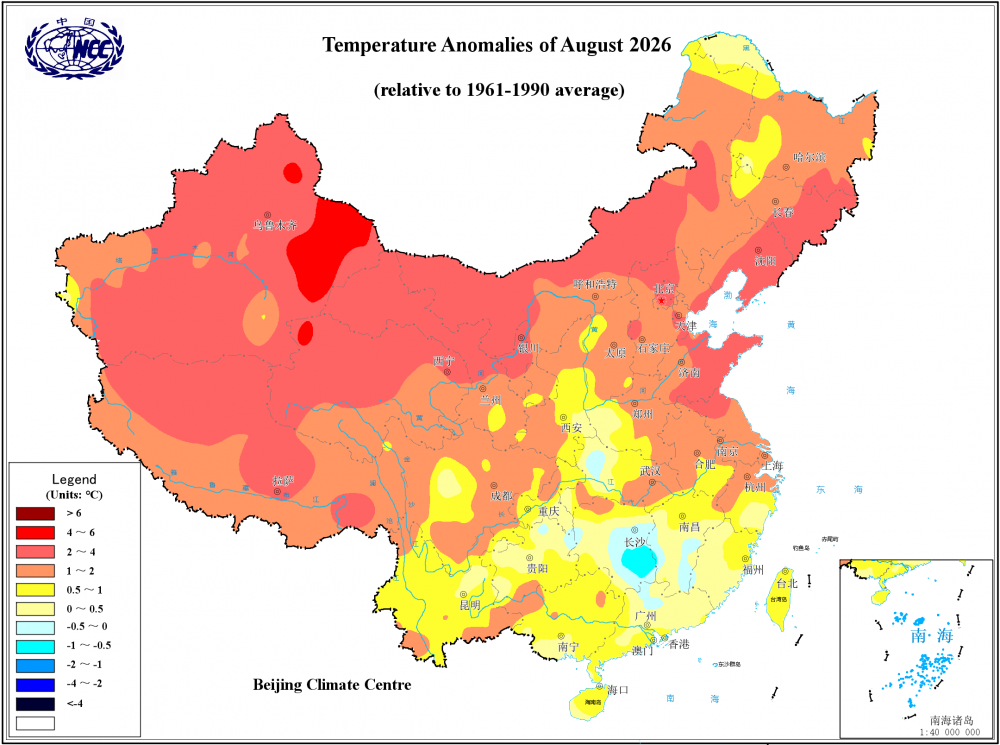
Figure 1. Distribution of August 2026 mean temperature anomalies (relative to 1961–1990 average; °C).
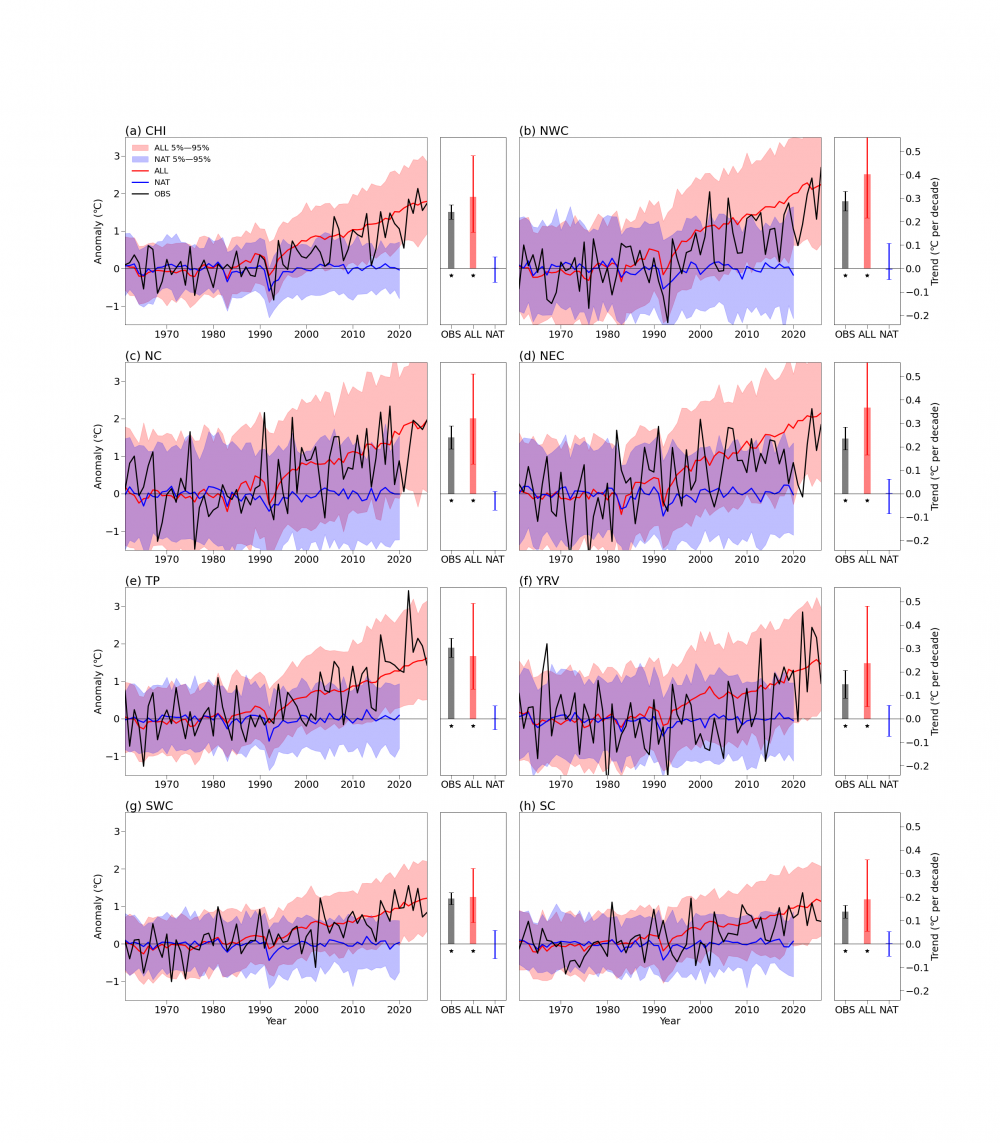
Figure 2. Left: Observed (OBS) and CMIP6-simulated (ALL: all-forcing; NAT: natural-forcing only) August mean temperature anomalies (relative to 1961–1990, °C) from 1961 to 2026 for China and its seven sub-regions. Shading indicates the 5%–95% multi-model ensemble range. Right: Corresponding warming trends (°C/decade). An asterisk (*) denotes significance at p < 0.05; vertical lines show 5%–95% confidence intervals. Region abbreviations: CHI (China), NWC (Northwest China), NC (North China), NEC (Northeast China), TP (Tibetan Plateau), YRV (Middle–Lower Yangtze River Valley), SWC (Southwest China), SC (South China).
Attribution Analysis
Attribution analysis based on CMIP6 models (Figs. 2 & 3) indicates that, under the current climate (2021–2031), human activities have increased the August mean temperature in Northwest China by 1.9 °C (90% confidence interval: 1.4 °C to 2.4 °C) and have increased the probability of 2026-like extreme heat events by a factor of 28.3 (25.2–32.5). For Northeast China, North China, and the Tibetan Plateau, anthropogenic forcing raised August mean temperatures by 1.8 °C (1.4–2.3 °C), 1.7 °C (1.2–2.1 °C), and 1.4 °C (1.0–1.8 °C), respectively, with corresponding probability of such events increases of about 5.6 (5.4–5.8), 5.0 (4.8–5.2), and 21.5 (20.0–23.1) times. In Southwest China, the Middle–Lower Yangtze River Valley, and South China, anthropogenic forcing contributed 1.0 °C (0.8–1.3 °C), 1.2 °C (0.9–1.6 °C), and 1.0 °C (0.7–1.2 °C) of warming, respectively. Without human influence, the mean temperature anomalies for these regions would have been near or below the baseline.
These results imply that human activities have significantly increased the likelihood of record‑breaking heat in Northwest China—without anthropogenic influence, extremes of this magnitude would have been exceptionally rare. In Southwest China, the Yangtze Valley, and South China, although anthropogenic warming does contribute, its effect is offset by internal variability, resulting in relatively modest observed warming.
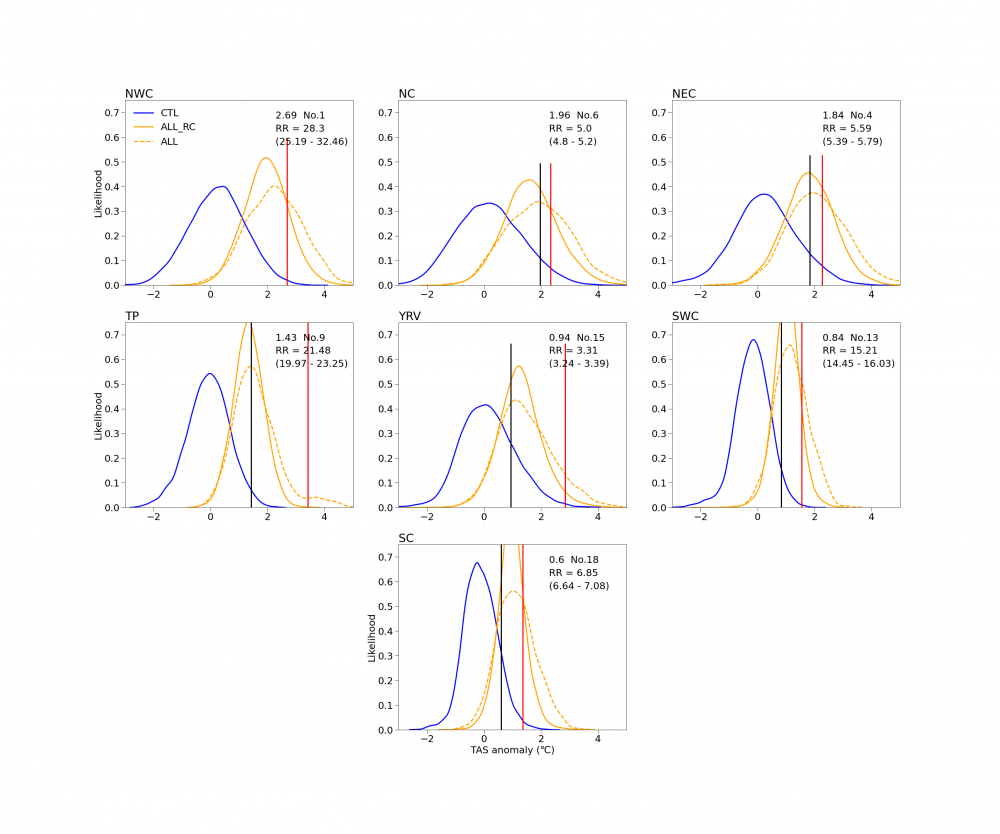
Figure 3. Human influence on the probability of August 2026 high-temperature anomalies across China’s seven regions. Solid blue and orange lines represent probability distributions under the current climate (2021–2031, 11-year window centered on 2026) for the pre-industrial control (CTL) experiments and the reconstructed ALL distribution (combining the adjusted anthropogenic forcing response with unforced internal variability), respectively. The orange dashed line shows the ALL-forcing distribution. Vertical lines mark thresholds for the August 2026 event (black) and the record-breaking event (red). Upper-right labels show event intensity, historical ranking, risk ratio (RR) of human influence, and its 5%–95% confidence intervals (from 1000 Bootstrap resamples).
Future Projections
Under the medium-emissions scenario (SSP2-4.5), CMIP6 multimodel projections (Fig. 4) indicate that over the next 5–10 years (2031–2036), the probability of August 2026-like extreme heat events in Northwest China will rise substantially, with a return period of 3.7 years (3.6–3.8). For Northeast China, North China, and the Tibetan Plateau, return periods for such events will approach 2 years, specifically 1.6 (1.6–1.7), 2.2 (2.1–2.2), and 1.7 (1.7–1.7) years, respectively. In Southwest China, the Middle–Lower Yangtze River Valley, and South China, 2026-like warm conditions will occur almost annually, whereas return periods for record breaking August heat events will be 5.1 (5.0–5.2), 19.5 (18.6–20.5), and 3.3 (3.3–3.4) years, respectively.
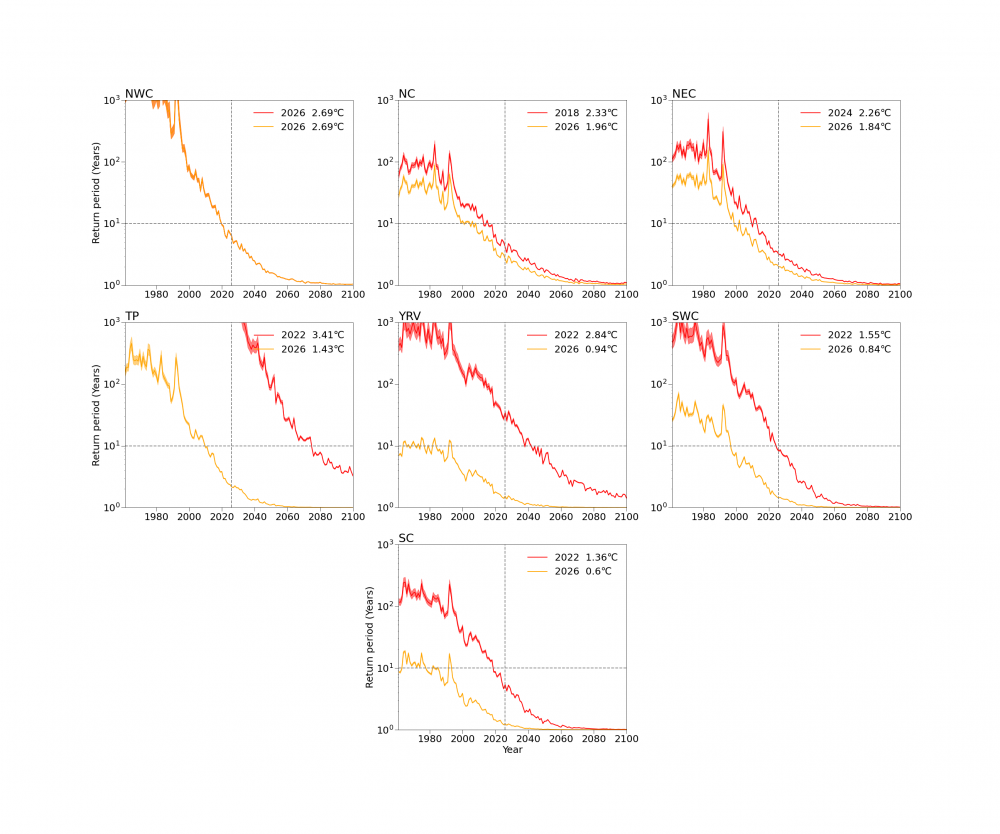
Figure 4. Changes in return periods for August high-temperature events in China’s seven regions from 1961 to 2100. Orange and red solid lines denote 2026-like and record-breaking events, respectively; shading indicates 5%–95% confidence intervals (from 1000 bootstrap resamples). Upper-right labels show event year and intensity.
Methodology
These results were obtained using the rapid attribution prototype for extreme high temperatures developed by the National Climate Centre. The prototype employs a CMIP6-based response-adjusted attribution method, integrating model output and observational data through preprocessing and model pre-evaluation to establish an optimized operational framework suitable for rapid attribution.
For further details, please refer to: Advances in Climate Change Research
(https://www.sciencedirect.com/science/journal/16749278)